*Registrations Open Now* for new Magellan3 workshop “Go Beyond the Limit (GBL)”
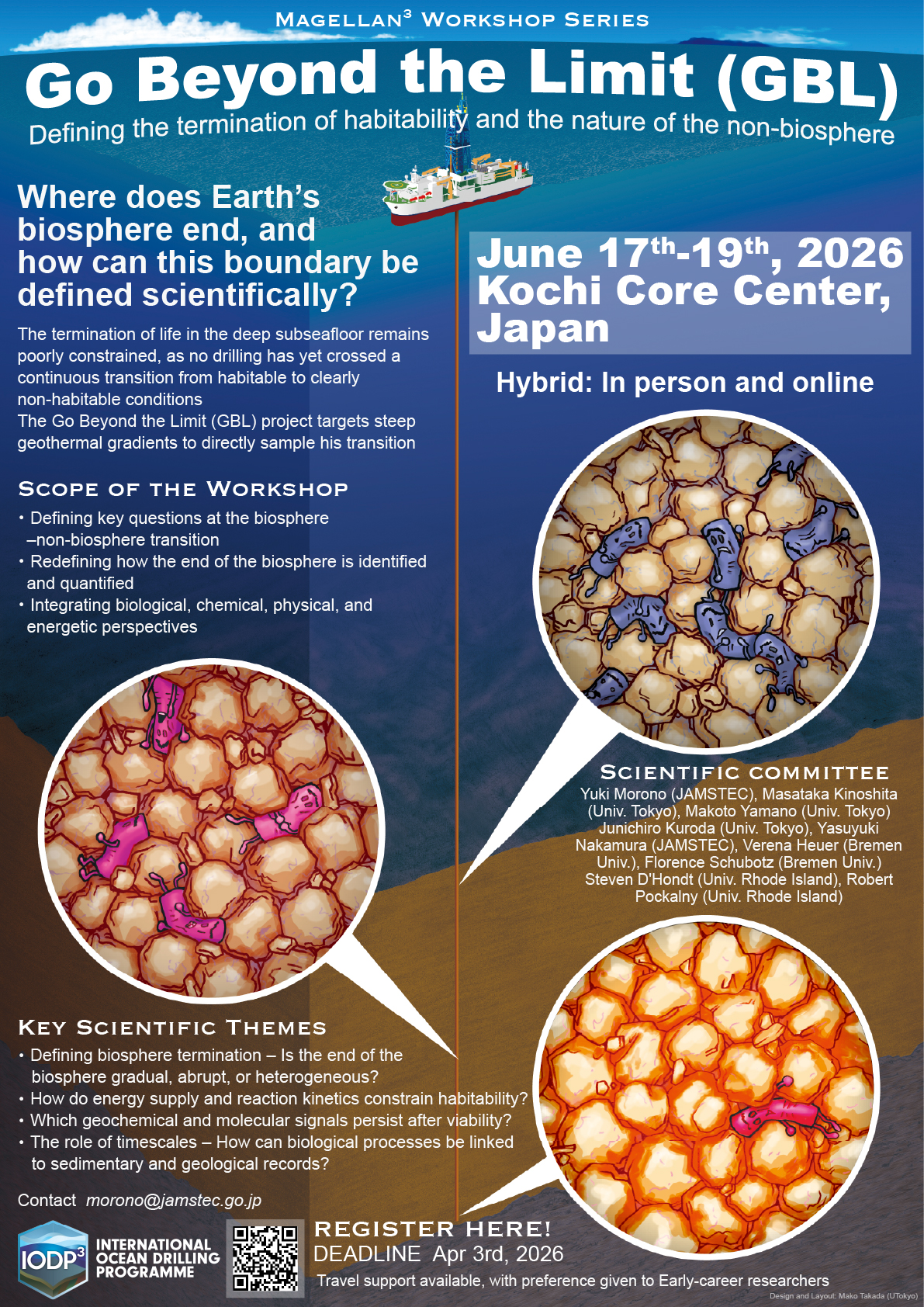
Scientists are invited to register now for Magellan3 workshop Go Beyond the Limit (GBL): Defining the termination of habitability and the nature of the non-biosphere through deep subseafloor drilling
Dates, Venue, and Format
Taking place June 16-19, 2026, at Kochi Core Center, Nankoku, Kochi, Japan this meeting will be in a hybrid format (on-site and on-line) at 9:00-17:00 JST (0:00-8:00 GMT, 19:00-4:00 CDT)
Background and Rationale
Where does Earth’s biosphere truly end, and how should this boundary be scientifically defined?
Despite decades of scientific ocean drilling, we have never directly crossed a continuous subsurface transition from clearly habitable conditions into environments that are demonstrably non-habitable. As a result, the termination of life in the deep subseafloor remains poorly constrained.
The Go Beyond the Limit (GBL) drilling project addresses this gap by targeting sedimentary sequences with steep geothermal gradients, enabling direct sampling across the habitable–non-habitable transition. With drilling sites now selected and a Full Drilling Proposal submitted, the central challenge has shifted from where to drill to how to extract the maximum scientific insight from crossing this boundary. This Magellan3 workshop is organized at this critical stage to ensure that the scientific potential of GBL is fully realized.
Scope of the Workshop
This workshop will focus on maximizing and sharpening the key scientific questions that can only be addressed by drilling across the biosphere–non-biosphere transition.
By bringing together expertise in microbiology, geochemistry, geophysics, sedimentology, and energetic modeling, the workshop aims to redefine how the “end of the biosphere” should be identified, interpreted, and quantified. Particular emphasis will be placed on integrating biological, chemical, physical, and energetic perspectives into a coherent framework for subsurface habitability.